Thesis Defense Presentation: Structure, Examples and Slide-by-Slide Outline
By the Premium Slides team · · 8 min read
Quick answer
A thesis defense presentation should cover your research problem, research questions, the gap in earlier work, your method, your key results, what they mean, the limitations and your contribution. For a 20-minute defense, plan about 15 to 20 slides, spend most of the time on method and results, and keep backup slides ready for the committee's questions.

Key takeaways
- Include the problem, research questions, gap, method, results, discussion, limitations and contribution.
- Spend most of the talk on method and results, because the committee has already read the background.
- A 20-minute defense usually fits in 15 to 20 slides, with one finding per results slide.
- Put detailed tables and extra analyses on backup slides after your closing slide.
- Prepare short answers on your method, limitations, contribution and next steps.
- Check your department's rules for length and format before you build anything.
You spent a year or more on the research. Now you have 20 minutes to show a committee that it holds up. The slides will not pass the defense for you, but a clear deck makes every minute count and gives you calm, solid ground when the questions start.
This guide covers what a thesis defense presentation should include, gives thesis defense presentation examples with a slide-by-slide outline, and walks you through preparing for the questions.
One note before you start: formats differ by country, university and level. Check your department's rules for talk length, slide format and who attends before you plan anything else.
What should be included in a thesis defense presentation?
A thesis defense presentation should include your research problem, research questions, a short review of what is already known, your method, your key results, what they mean, the limitations and your contribution. It opens with a title slide and closes with a summary and a slide that invites questions.
Think of the deck as the thesis told in the order a listener needs it, not the order of your chapters:
- Title. Thesis title, your name, your programme, your supervisor and the date.
- Outline. The four or five parts of the talk, so the committee knows the route.
- Problem and motivation. Why this question matters and who cares about the answer.
- Research questions or hypotheses. Stated exactly as in the thesis.
- Background and gap. Two or three key sources and the gap your work fills. Not a full literature review.
- Method. Design, data, sample and analysis, with the reason for each choice.
- Results. The findings that answer your questions, one finding per slide.
- Discussion. What the results mean and how they compare with earlier work.
- Limitations and future work. Name them before the committee does.
- Contribution and conclusion. What is new because of your work, in one or two sentences.

A clean table of contents slide is worth the effort. It tells the committee that the talk is planned, and you can show it again as a divider between sections.
Thesis defense examples: what does a 20-minute deck look like?
A 20-minute thesis defense usually fits in 15 to 20 slides, with most of the time spent on method and results. Here is a sample outline you can adapt. The times are a guide, not a rule.
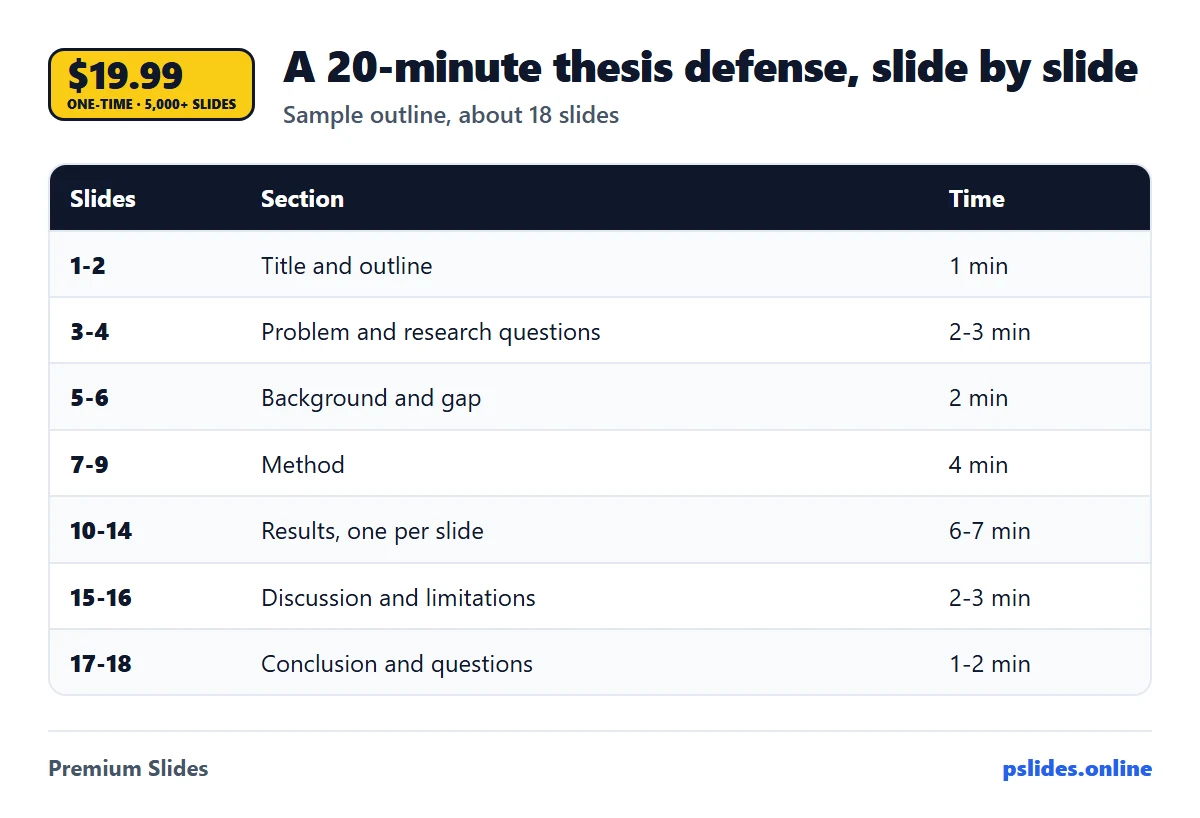
| Slides | Section | Time |
|---|---|---|
| 1 to 2 | Title and outline | 1 minute |
| 3 to 4 | Problem, motivation and research questions | 2 to 3 minutes |
| 5 to 6 | Background and research gap | 2 minutes |
| 7 to 9 | Method: design, data and analysis | 4 minutes |
| 10 to 14 | Results, one finding per slide | 6 to 7 minutes |
| 15 to 16 | Discussion, limitations and future work | 2 to 3 minutes |
| 17 to 18 | Contribution, conclusion and questions | 1 to 2 minutes |
Notice where the time goes. Students often spend half the talk on background because it feels safe. The committee has read the thesis. They want to hear what you did and what you found.
How to do a thesis defense presentation, step by step
Start from your research questions, build one slide per idea, rehearse with a timer and prepare backup slides for the hard questions. Here is the process in order.
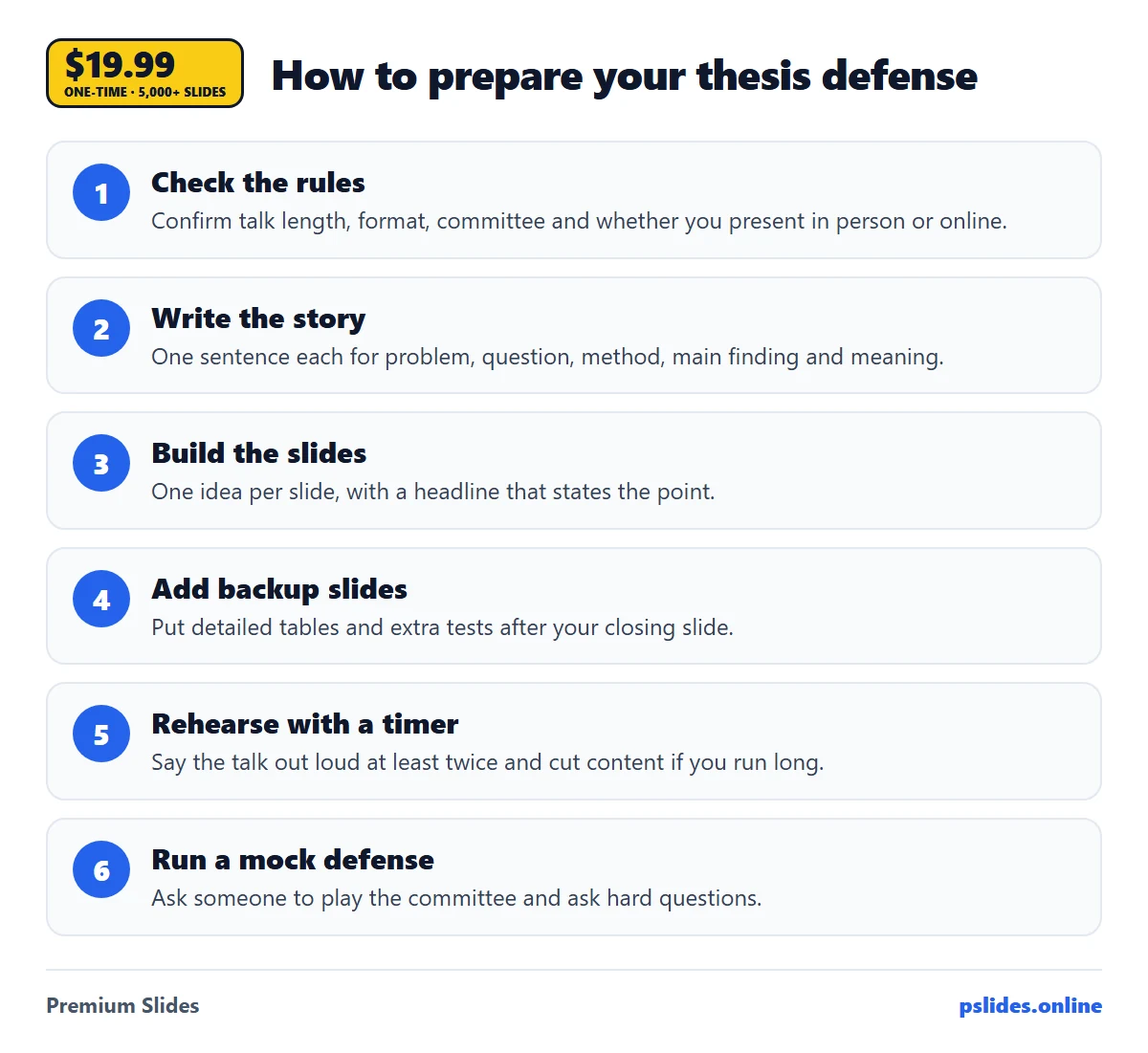
1. Check the rules
Find out the talk length, who sits on the committee, whether the public can attend and whether you present in person or online. Ask your supervisor what past defenses looked like.
2. Write the story before the slides
Write one sentence for each part: problem, question, method, main finding, meaning. If you cannot say your main finding in one sentence, the committee will struggle to follow it.
3. Build the slides
Give each slide a headline that states its point, such as "Remote teams replied more slowly after the move", not just "Results". Use charts instead of tables wherever you can, and keep text to what supports what you say.
4. Add backup slides
Place extra slides after your closing slide: detailed tables, extra tests, sample questions from a survey. When a committee member asks, you jump straight to the answer.
5. Rehearse with a timer
Say the whole talk out loud at least twice. Most people run long on the first try. Cut content, not speaking speed.
6. Run a mock defense
Ask a supervisor, a lab mate or a friend to play the committee and ask hard questions. It is the closest you can get to the real thing.
Thesis defence presentation example: a master's project in 15 slides
Here is a made-up example to show the structure in practice. Imagine a master's student whose thesis asks how remote work affects communication in small software teams. The defense slot is 15 minutes plus questions.
- Title: thesis title, name, programme, supervisor, date.
- Outline: problem, method, findings, meaning.
- Problem: small teams moved to remote work, and nobody measured what happened to their communication.
- Research questions: two questions, word for word from the thesis.
- Gap: earlier studies looked at large firms. Small teams are missing.
- Method: a survey of team members plus interviews, shown as a four-step process.
- Sample: who took part and how they were chosen.
- Finding 1: a chart of response times before and after the move.
- Finding 2: a donut chart of preferred channels.
- Finding 3: three interview quotes that explain the numbers.
- Discussion: how the findings fit with studies of larger firms.
- Limitations: small sample, self-reported data, one country.
- Contribution: what is now known about small teams that was not before.
- Conclusion: the answer to each research question in one line.
- Questions: a simple closing slide, with backup slides after it.

Each finding gets its own slide with one chart and one headline. Ready-made chart slides save time here, because you only replace the numbers.

How many slides should a thesis defense have?
A common rule of thumb is about one slide per minute, which gives 18 to 22 simple slides for a 20-minute talk. Results slides with charts take longer to explain, so most 20-minute defenses land at 15 to 20 slides, and a very data-heavy one can use even fewer.
Many master's defenses ask for a talk of 15 to 20 minutes, and many PhD defenses for 20 to 45 minutes, followed by questions. These are common ranges, not rules, so follow your department. For a full chart by talk length, see how many slides you need for a presentation.

What questions does the committee ask at a thesis defense?
Most questions fall into a few groups: why you chose your method, what your results really show, what the limitations are and what you would do next. You can prepare for nearly all of them.
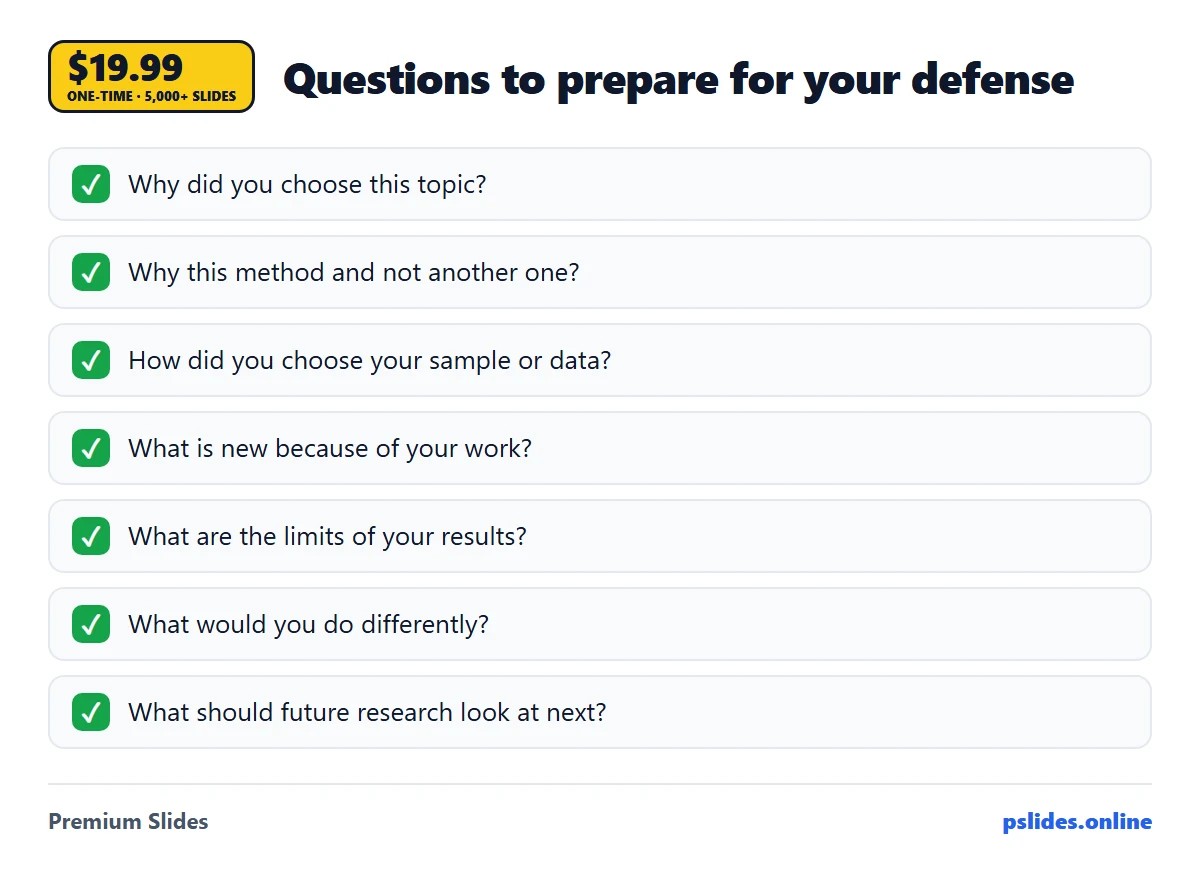
- Why did you choose this topic, and why does it matter?
- Why this method and not another one?
- How did you choose your sample or data?
- What is your main contribution, in one sentence?
- What are the main limitations, and how do they affect the results?
- What would you do differently if you started again?
- What should future research look at next?
When you answer, listen to the whole question, pause, and repeat it in your own words if it was long. Answer in two or three sentences and stop. If you do not know, say so and explain how you would find out. That is a much better answer than a guess.
What are the most common thesis defense slide mistakes?
Too much text, too much background, unreadable charts and no clear conclusion. Each one has a simple fix.
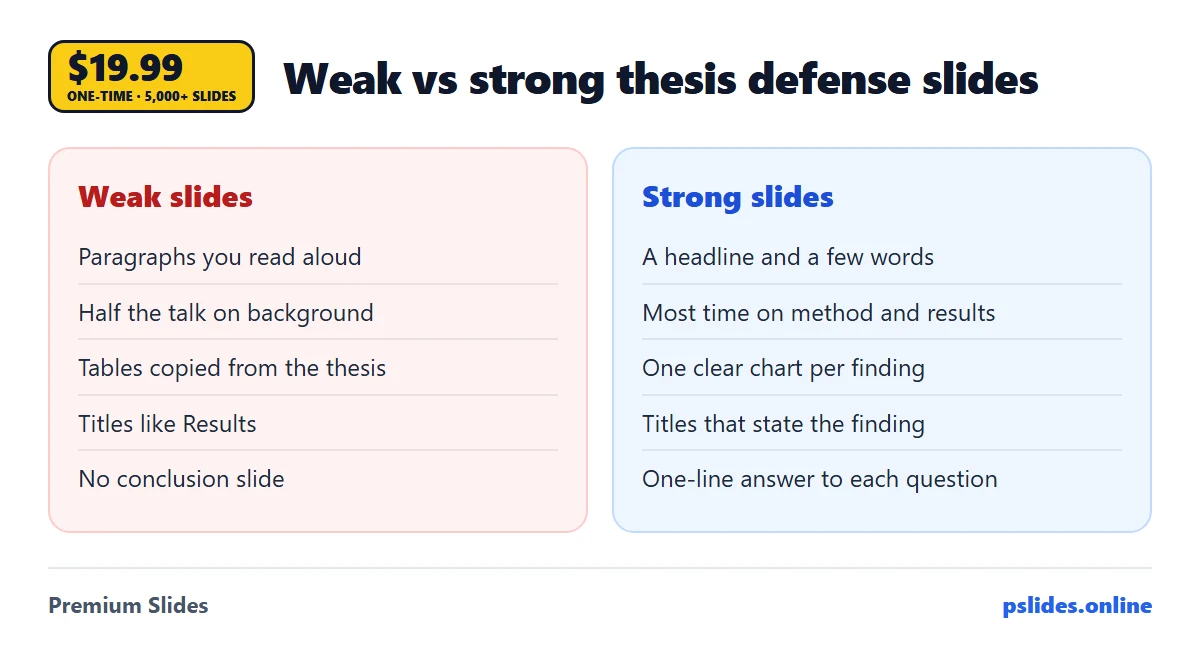
- Paragraphs on slides. If you read the slide aloud, the committee reads ahead and stops listening. Keep a headline and a few words, and say the rest.
- Tables copied from the thesis. A full results table is too small to read on a screen. Show one chart and move the table to a backup slide.
- Labels instead of statements. "Results" tells the room nothing. "Response times rose after the move" tells them your finding.
- No conclusion slide. End with your answer to each research question. It is the slide the committee remembers.
- Inconsistent design. Mixed fonts and colours make a deck look rushed. Our guide on making PowerPoint look professional covers the basics.
If the committee joins online, share only the slide window and test your screen sharing the day before. If you are unsure which app to build in, compare PowerPoint, Google Slides and Keynote first.
How can you build your thesis defense deck faster?
Your time is better spent on the research story and the rehearsal than on drawing arrows and aligning boxes. A template gives you the outline slide, the process slide, the chart slides and the closing slide, all in one consistent style.
Premium Slides is a bundle of 5,000+ animated, fully editable slides for PowerPoint, Google Slides and Keynote. It includes education templates, chart slides, outline slides and closing slides, so you can build a defense deck by choosing layouts and adding your own content. The whole bundle costs $19.99 once, with instant download and lifetime access. You can get the bundle here or browse every template category first.
Frequently asked questions
How long is a thesis defense presentation?
It depends on your university and level. Many master's defenses ask for 15 to 20 minutes and many PhD defenses for 20 to 45 minutes, followed by questions, so always check your department's rules.
How many slides should a thesis defense have?
About one slide per minute is a common rule of thumb. Results slides take longer to explain, so 15 to 20 slides suits most 20-minute defenses, and fewer if most slides are detailed charts.
What is the structure of a thesis defense presentation?
Title, outline, problem and research questions, background and gap, method, results, discussion and limitations, contribution and conclusion, then questions.
Should I include a literature review in my defense?
Only a short one. Show two or three key sources and the gap your work fills, then move on, because the committee has read the full review in your thesis.
What if I cannot answer a question at my defense?
Say that you do not know and explain how you would find out. An honest answer with a clear next step is better than a guess.